
How to Launch Motorcycle Telematics Insurance in 5 Steps (Guide for Insurers)

200,000+ DEVICES DEPLOYED GLOBALLY
99.99% DEVICE UPTIME
90% IRISH MARKET SHARE
ONE DEVICE-AGNOSTIC PLATFORM
Motorcycle telematics is an increasingly important opportunity for insurers building usage based insurance programmes. The market remains less developed than car telematics, but demand for connected motorcycles, rider analytics, crash detection and digital claims intelligence is accelerating.
MarketsandMarkets projects the connected motorcycle market to grow from $0.52 billion in 2026 to $3.30 billion by 2033, representing a 30.3% compound annual growth rate.
For insurers, the opportunity is clear. Motorcycle usage based insurance can support more accurate pricing, better rider engagement, faster claims decisions and stronger fraud controls. The challenge is execution. Motorcycles require different hardware, different scoring logic and different operational processes from passenger cars.
This guide sets out the five stages required to launch a robust motorcycle telematics insurance programme.
1. Define the Commercial Model Before Selecting Technology
A successful programme starts with the insurance proposition, not the device.
Decide what your motorcycle telematics programme needs to achieve:
- More accurate risk segmentation
- Safer riding incentives
- Mileage or usage-based pricing
- Faster first notification of loss (FNOL)
- Better crash severity assessment
- Fraud detection and claims validation
- Improved retention through transparent pricing
These objectives determine the data you need, the frequency of collection, the scoring model and the customer experience.
A mileage-based policy may require distance, time of use and journey frequency. A behaviour-based policy requires more detailed information about speed, braking, acceleration, cornering and rider context. A claims-focused programme requires reliable impact detection, event timing, post-impact movement and forensic reconstruction.
Do not treat these as separate technology projects. A unified motorcycle telematics platform should connect pricing, claims, fraud and customer engagement through one coherent data model.
Establish the operating model
Before launch, define:
- Target segment : private riders, young riders, high-value motorcycles, electric motorcycles, touring users or commercial two-wheelers.
- Pricing logic : upfront discount, score-based renewal pricing, per-mile pricing or a blended model.
- Customer journey : quotation, consent, device installation, onboarding, feedback and renewal.
- Claims workflow : crash alert, FNOL triage, investigation, settlement and fraud escalation.
- Success metrics : loss ratio, claims frequency, severity, retention, installation completion and device uptime.
The result should be a clear commercial specification for your telematics service provider. Without it, insurers risk buying disconnected hardware and building the operating model afterwards.
2. Select Hardware Designed for Two-Wheelers
Motorcycle fitment is not a smaller version of car fitment. The operating environment is different, and the device must be selected accordingly.
Motorcycles expose hardware to:
- Rain, road spray and temperature changes
- Continuous vibration
- Limited installation space
- Restricted battery capacity
- Complex or variable power access
- Theft and tampering risks
- Different mounting angles and orientations
A suitable motorcycle telematics device must be compact, robust and weather-resistant. It must support reliable cellular and GNSS connectivity while operating within the motorcycle’s available power profile.
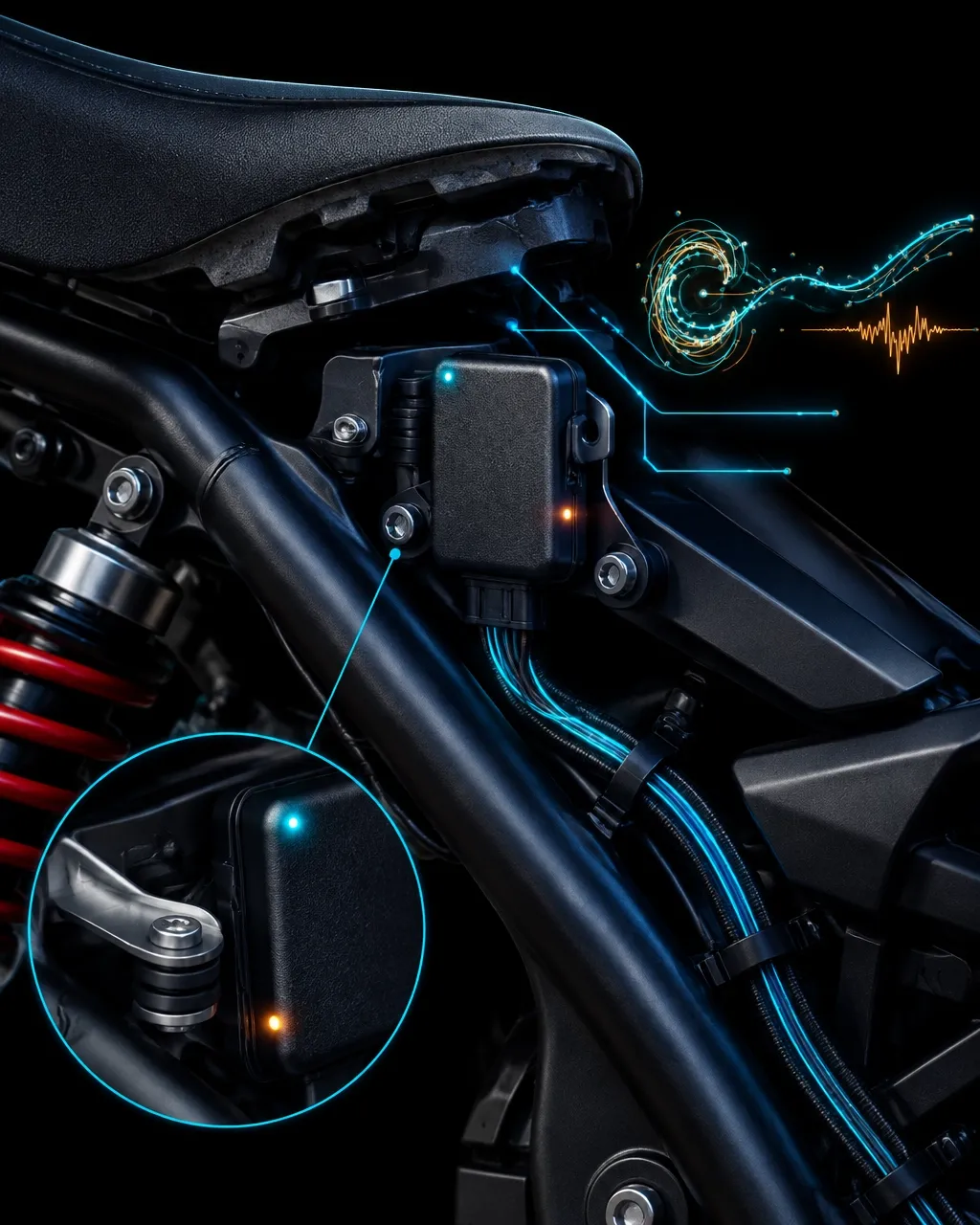
Evaluate the complete fitment, not just the unit
Your assessment should cover:
- Weatherproofing: Is the enclosure suitable for exposure to water, dust and road contaminants?
- Vibration resistance: Can the device maintain accurate sensor readings during prolonged vibration?
- Power management: Does it protect the motorcycle battery and support low-power operation when parked?
- Mounting: Can it be secured discreetly without affecting rider safety or vehicle maintenance?
- Tamper resilience: Can unauthorised removal or power interruption be detected?
- Sensor orientation: Can the installation process account for different motorcycle geometries?
- Connectivity: Does the device maintain reliable transmission across the required markets?
A device-agnostic architecture gives insurers more flexibility. It allows approved hardware to be selected according to vehicle type, programme objective, geography and cost, without forcing the entire insurance proposition into one device ecosystem.
This also protects future deployment. As motorcycle models, connectivity standards and customer requirements change, you can evolve the hardware without rebuilding the platform.
3. Build a Rider Score That Reflects Motorcycle Dynamics
Car-based driver scoring models cannot simply be transferred to motorcycles.
Motorcycles corner differently, lean through bends and respond more directly to rider inputs. A behaviour model that treats every lateral movement as an adverse event will penalise normal riding. A model that ignores lean angle, trajectory and road context will fail to distinguish controlled riding from genuine risk.
The scoring model must be calibrated around motorcycle dynamics.
Core scoring inputs
A motorcycle behaviour score may incorporate:
- Speed relative to road conditions and limits
- Harsh acceleration
- Harsh braking
- Cornering intensity
- Lean angle and lean-rate changes
- Rapid changes in direction
- Time of day
- Journey duration and frequency
- Road type and route context
- Repeated high-risk events
The objective is not to measure movement in isolation. It is to interpret movement accurately.
A rider leaning into a controlled bend is not automatically demonstrating unsafe behaviour. The model must consider speed, acceleration, lateral forces, road geometry and event duration before assigning a risk classification.
Make the score explainable
A score only creates value when riders, underwriters and claims teams understand how it was produced.
Use clear event categories and simple explanations:
- High-speed cornering
- Severe braking
- Rapid acceleration
- Unusual riding time
- Repeated high-risk routes
- Confirmed impact event
This supports fairer pricing and better engagement. It also gives insurers a defensible basis for underwriting decisions and customer communications.
Axon’s platform supports high-rate IMU data, sensor fusion and normalised signals across approved hardware. Its core modules connect behaviour scoring with claims intelligence, device management and operational workflows. That means your usage based insurance model is built on interpretable data rather than a black-box score.
4. Engineer Crash Detection and Forensic Reconstruction Into the Programme
Motorcycle claims often involve serious injury, disputed liability and complex event sequences. Crash intelligence must therefore do more than trigger an alert.
A reliable system should establish:
- Whether an impact occurred
- When it occurred
- The direction and severity of the impact
- What the motorcycle was doing beforehand
- Whether there were secondary impacts
- What happened immediately afterwards
- Whether the event is consistent with the reported claim

Use multi-sensor evidence
Modern reconstruction should combine:
- High-rate accelerometer data
- Gyroscope data
- GPS speed and heading
- Impact direction
- Pre-impact braking and acceleration
- Post-impact movement
- Vehicle signals where available
Axon’s crash reconstruction engine uses event segmentation, per-axis impact classification, sensor fusion, millisecond timing and integrated delta-v. These capabilities help claims handlers distinguish a genuine collision from a pothole, kerb strike or harsh braking event.
For motorcycles, rollover and fall detection are particularly important. A rider may lose control without producing the same longitudinal impact signature as a car. Sustained rotation, lateral movement and post-event immobility can provide critical context.
Connect detection to FNOL
Crash detection only delivers commercial value when it reaches the right workflow.
The programme should support:
- Automatic event classification
- Confidence scoring
- Claims queue prioritisation
- Immediate customer contact where appropriate
- Emergency escalation protocols
- Automated evidence capture
- Fraud and liability review
High-resolution data reduces false alerts and gives claims teams more confidence in genuine events. Axon’s analysis of the false FNOL problem explains how sensor resolution and event context improve the distinction between real crashes and non-events.
5. Operationalise the Full Programme Lifecycle
Technology is only one part of motorcycle insurance telematics. The programme must work in the field, at scale and throughout the policy lifecycle.
Others provide a device. Axon manages the operating system around it.
A dependable telematics service provider should cover:
- Programme consultancy
- Device sourcing and logistics
- Customer communications
- Professional installation
- SIM and airtime provision
- Device activation
- Device health monitoring
- Data ingestion and normalisation
- Claims and FNOL integration
- Customer support
- Device replacement
- Firmware and configuration management
- Ongoing aftercare

Create a controlled rollout
A practical launch sequence includes:
01 : Design
Define the target customer, pricing model, data requirements, integrations and regulatory controls.
02 : Pilot
Deploy across a controlled motorcycle segment. Test fitment, connectivity, scoring accuracy, customer onboarding and claims workflows.
03 : Validate
Compare telematics events against claims records, installation data and customer feedback. Tune the model before scaling.
04 : Scale
Expand deployment through structured logistics, professional installation and automated device management.
05 : Optimise
Monitor uptime, data quality, claims outcomes, fraud indicators, retention and loss ratio performance.
This is where end-to-end ownership creates a measurable advantage. Device uptime, installation quality and support responsiveness directly affect the quality of the insurance data. Gaps at any stage weaken pricing confidence and increase operational cost.
Axon has deployed more than 200,000 devices globally, holds 90% Irish market share and delivers 99.99% device uptime. Its full-stack model covers consultancy, logistics, installation, connectivity, management and aftercare through one accountable partner.
Launch Motorcycle Telematics With Control
Motorcycle telematics is no longer an experimental extension of car insurance. It is a growing insurance opportunity with distinct hardware, scoring, claims and operational requirements.
The winning model is integrated:
- Select hardware built for two-wheelers.
- Score behaviour against motorcycle dynamics.
- Reconstruct crashes with high-resolution evidence.
- Connect insight directly to FNOL, claims and fraud workflows.
- Manage every stage from deployment to aftercare.
A device is not a programme. Data alone is not intelligence. The commercial advantage comes from combining accurate signals, explainable models and dependable operations.
Axon provides the device-agnostic, full-stack infrastructure insurers need to launch and scale motorcycle usage based insurance with confidence.